

2025 Valid 312-50v13 Exam Updates - 2025 Study Guide
312-50v13 Certification - The Ultimate Guide [Updated 2025]
NEW QUESTION # 45
Which type of malware spreads from one system to another or from one network to another and causes similar types of damage as viruses do to the infected system?
- A. Trojan
- B. Rootkit
- C. Adware
- D. Worm
Answer: D
NEW QUESTION # 46
What is the purpose of a DNS AAAA record?
- A. Address database record
- B. Address prefix record
- C. IPv6 address resolution record
- D. Authorization, Authentication and Auditing record
Answer: C
Explanation:
Comprehensive and Detailed Explanation:
The AAAA (Quad A) record is the DNS record type used to map a domain name to an IPv6 address. It is the IPv6 equivalent of an A (Address) record, which maps to an IPv4 address.
From CEH v13 Courseware:
Module 4: Enumeration # DNS Record Types
Reference:IETF RFC 3596 - DNS Extensions for IPv6
NEW QUESTION # 47
An experienced cyber attacker has created a fake Linkedin profile, successfully impersonating a high-ranking official from a well-established company, to execute a social engineering attack. The attacker then connected with other employees within the organization, receiving invitations to exclusive corporate events and gaining access to proprietary project details shared within the network. What advanced social engineering technique has the attacker primarily used to exploit the system and what is the most likely immediate threat to the organization?
- A. Pretexting and Network Vulnerability
- B. Spear Phishing and Spam
- C. Whaling and Targeted Attacks
- D. Baiting and Involuntary Data Leakage
Answer: C
Explanation:
Whaling is an advanced social engineering technique that targets high-profile individuals, such as executives, managers, or celebrities, by impersonating them or someone they trust, such as a colleague, partner, or vendor. The attacker creates a fake Linkedin profile, pretending to be a high-ranking official from a well- established company, and uses it to connect with other employees within the organization. The attacker then leverages the trust and authority of the fake profile to gain access to exclusive corporate events and proprietary project details shared within the network. This way, the attacker can launch targeted attacks against the organization, such as stealing sensitive data, compromising systems, or extorting money.
The most likely immediate threat to the organization is the loss of confidential information and intellectual property, which can damage the organization's reputation, competitiveness, and profitability. The attacker can also use the information to launch further attacks, such as ransomware, malware, or sabotage, against the organization or its partners and customers.
The other options are not as accurate as whaling for describing this scenario. Pretexting is a social engineering technique that involves creating a false scenario or identity to obtain information or access from a victim.
However, pretexting usually involves direct communication with the victim, such as a phone call or an email, rather than creating a fake Linkedin profile and connecting with the victim's network. Spear phishing is a social engineering technique that involves sending a personalized and targeted email to a specific individual or group, usually containing a malicious link or attachment. However, spear phishing does not involve creating a fake Linkedin profile and connecting with the victim's network. Baiting and involuntary data leakage are not social engineering techniques, but rather possible outcomes of social engineering attacks.
Baiting is a technique that involves offering something enticing to the victim, such as a free download, a gift card, or a job opportunity, in exchange for information or access. Involuntary data leakage is a situation where the victim unintentionally or unknowingly exposes sensitive information to the attacker, such as by clicking on a malicious link, opening an infected attachment, or using an unsecured network. References:
* Whaling: What is a whaling attack?
* Advanced Social Engineering Attack Techniques
* Top 8 Social Engineering Techniques and How to Prevent Them
NEW QUESTION # 48
A company's security policy states that all Web browsers must automatically delete their HTTP browser cookies upon terminating. What sort of security breach is this policy attempting to mitigate?
- A. Attempts by attackers to access password stored on the user's computer without the user's knowledge.
- B. Attempts by attackers to access Web sites that trust the Web browser user by stealing the user's authentication credentials.
- C. Attempts by attackers to access the user and password information stored in the company's SQL database.
- D. Attempts by attackers to determine the user's Web browser usage patterns, including when sites were visited and for how long.
Answer: B
NEW QUESTION # 49
Sam is working as a system administrator In an organization. He captured the principal characteristics of a vulnerability and produced a numerical score to reflect Its severity using CVSS v3.0 to property assess and prioritize the organization's vulnerability management processes. The base score that Sam obtained after performing cvss rating was 4.0. What is the CVSS severity level of the vulnerability discovered by Sam in the above scenario?
- A. Low
- B. High
- C. Critical
- D. Medium
Answer: D
Explanation:
Rating CVSS Score
None 0.0
Low 0.1 - 3.9
Medium 4.0 - 6.9
High 7.0 - 8.9
Critical 9.0 - 10.0
https://www.first.org/cvss/v3.0/specification-document
The Common Vulnerability Scoring System (CVSS) is an open framework for communicating the characteristics and severity of software vulnerabilities. CVSS consists of three metric groups: Base, Temporal, and Environmental. The Base metrics produce a score ranging from 0 to 10, which can then be modified by scoring the Temporal and Environmental metrics. A CVSS score is also represented as a vector string, a compressed textual representation of the values used to derive the score. Thus, CVSS is well suited as a standard measurement system for industries, organizations, and governments that need accurate and consistent vulnerability severity scores. Two common uses of CVSS are calculating the severity of vulnerabilities discovered on one's systems and as a factor in prioritization of vulnerability remediation activities. The National Vulnerability Database (NVD) provides CVSS scores for almost all known vulnerabilities.
Qualitative Severity Rating Scale
For some purposes, it is useful to have a textual representation of the numeric Base, Temporal and Environmental scores.
Table Description automatically generated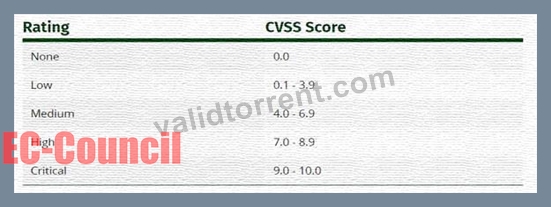
NEW QUESTION # 50
Which of the following types of SQL injection attacks extends the results returned by the original query, enabling attackers to run two or more statements if they have the same structure as the original one?
- A. Error-based injection
- B. Blind SQL injection
- C. Union SQL injection
- D. Boolean-based blind SQL injection
Answer: B
NEW QUESTION # 51
Jake, a professional hacker, installed spyware on a target iPhone to spy on the target user's activities. He can take complete control of the target mobile device by jailbreaking the device remotely and record audio, capture screenshots, and monitor all phone calls and SMS messages. What is the type of spyware that Jake used to infect the target device?
- A. Zscaler
- B. Trident
- C. DroidSheep
- D. Androrat
Answer: B
NEW QUESTION # 52
In Trojan terminology, what is a covert channel?
- A. A channel that transfers information within a computer system or network in a way that violates the security policy
- B. It is Reverse tunneling technique that uses HTTPS protocol instead of HTTP protocol to establish connections
- C. A legitimate communication path within a computer system or network for transfer of data
- D. It is a kernel operation that hides boot processes and services to mask detection
Answer: A
NEW QUESTION # 53
James is working as an ethical hacker at Technix Solutions. The management ordered James to discover how vulnerable its network is towards footprinting attacks. James took the help of an open-source framework for performing automated reconnaissance activities. This framework helped James in gathering information using free tools and resources.
What is the framework used by James to conduct footprinting and reconnaissance activities?
- A. Browser Exploitation Framework
- B. OSINT framework
- C. SpeedPhish Framework
- D. WebSploit Framework
Answer: B
Explanation:
In CEH v13 Module 02: Footprinting and Reconnaissance, the OSINT Framework is introduced as a collection of free, open-source tools and resources to aid ethical hackers in passive reconnaissance.
Key Features of OSINT Framework:
Web-based visual tool that maps out links to open-source intelligence tools.
Allows collection of emails, domains, usernames, IPs, social media data, and more.
Focuses on passive footprinting to avoid detection.
Option Clarification:
A: WebSploit Framework: Used for man-in-the-middle attacks and web vulnerabilities.
B: Browser Exploitation Framework (BeEF): Browser-focused attack tool.
C: OSINT Framework: Correct - open-source intelligence and reconnaissance.
D: SpeedPhish Framework: Phishing simulation tool, not used for passive information gathering.
Reference:
Module 02 - Tools for Footprinting and Reconnaissance
CEH iLabs: Using OSINT Framework for Target Profiling
NEW QUESTION # 54
An attacker can employ many methods to perform social engineering against unsuspecting employees, including scareware.
What is the best example of a scareware attack?
- A. A banner appears to a user stating, "Your Amazon order has been delayed. Click here to find out your new delivery date."
- B. A pop-up appears to a user stating, "You have won a free cruise! Click here to claim your prize!"
- C. A pop-up appears to a user stating, "Your computer may have been infected with spyware. Click here to install an anti-spyware tool to resolve this issue."
- D. A banner appears to a user stating, "Your account has been locked. Click here to reset your password and unlock your account."
Answer: C
Explanation:
In CEH v13 Module 09: Social Engineering, scareware is defined as a malicious tactic that uses fear, panic, or urgency to trick users into performing harmful actions such as downloading fake software or clicking malicious links.
Common Scareware Example:
A pop-up warns the user: "Your system is infected! Install this antivirus now!" Victim downloads malware disguised as a solution.
Often used to deliver spyware, ransomware, or trojans.
Option Review:
A). Free cruise: Classic example of baiting, not scareware.
B). Account locked: Closer to phishing or credential harvesting.
C). Delivery delay: Another phishing variation.
D). Pop-up about infection: True scareware tactic.
Reference:
Module 09 - Social Engineering Attacks # Scareware Attacks
CEH iLabs: Identifying Fake Security Alerts and Scareware Payloads
NEW QUESTION # 55
Suppose your company has just passed a security risk assessment exercise. The results display that the risk of the breach in the main company application is 50%. Security staff has taken some measures and implemented the necessary controls. After that, another security risk assessment was performed showing that risk has decreased to 10%. The risk threshold for the application is 20%. Which of the following risk decisions will be the best for the project in terms of its successful continuation with the most business profit?
- A. Avoid the risk
- B. Mitigate the risk
- C. Introduce more controls to bring risk to 0%
- D. Accept the risk
Answer: D
Explanation:
Risk Mitigation
Risk mitigation can be defined as taking steps to reduce adverse effects. There are four types of risk mitigation strategies that hold unique to Business Continuity and Disaster Recovery. When mitigating risk, it' s important to develop a strategy that closely relates to and matches your company's profile.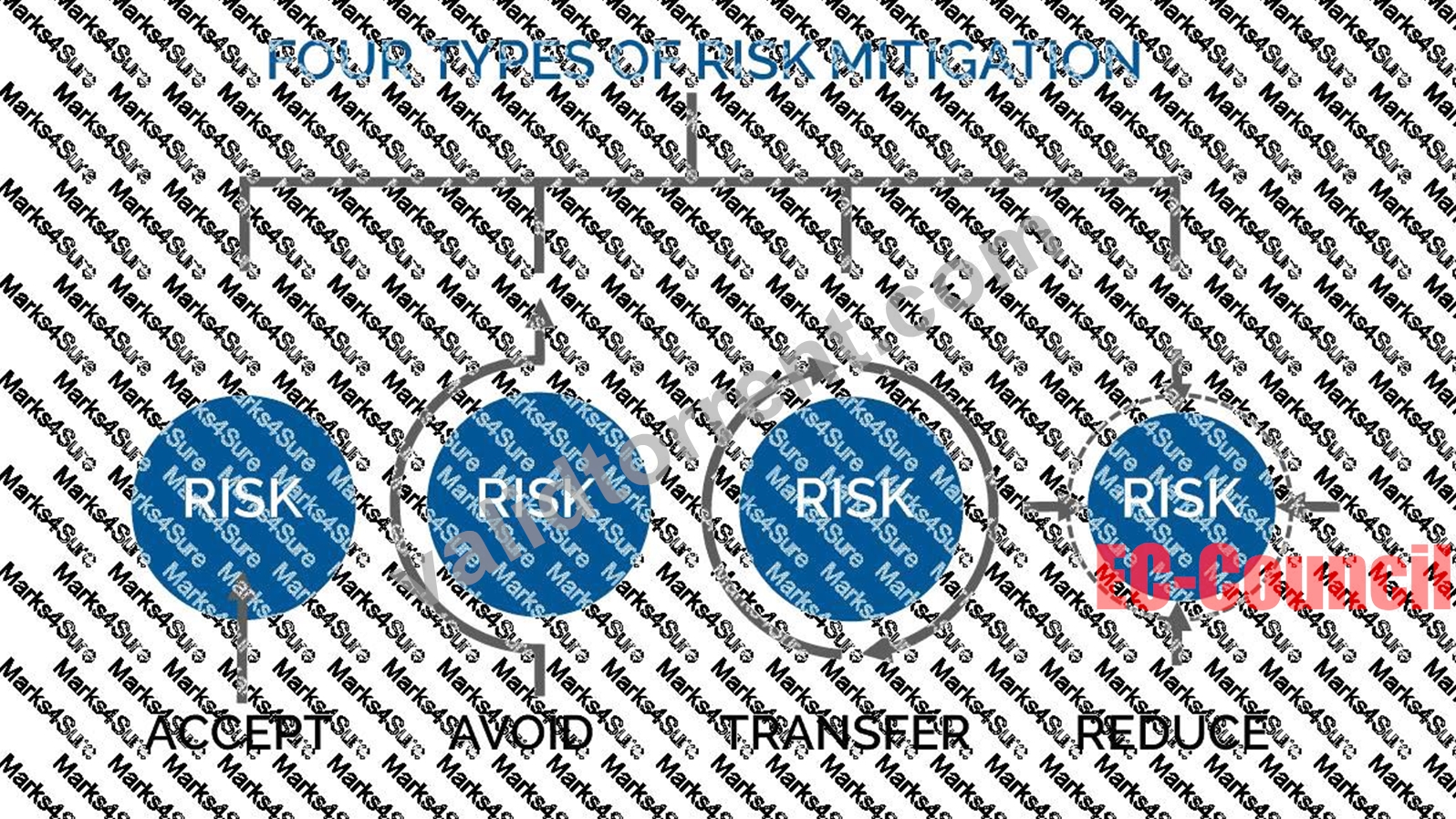
Risk Acceptance
Risk acceptance does not reduce any effects; however, it is still considered a strategy. This strategy is a common option when the cost of other risk management options such as avoidance or limitation may outweigh the cost of the risk itself. A company that doesn't want to spend a lot of money on avoiding risks that do not have a high possibility of occurring will use the risk acceptance strategy.
Risk Avoidance
Risk avoidance is the opposite of risk acceptance. It is the action that avoids any exposure to the risk whatsoever. It's important to note that risk avoidance is usually the most expensive of all risk mitigation options.
Risk Limitation
Risk limitation is the most common risk management strategy used by businesses. This strategy limits a company's exposure by taking some action. It is a strategy employing a bit of risk acceptance and a bit of risk avoidance or an average of both. An example of risk limitation would be a company accepting that a disk drive may fail and avoiding a long period of failure by having backups.
Risk Transference
Risk transference is the involvement of handing risk off to a willing third party. For example, numerous companies outsource certain operations such as customer service, payroll services, etc. This can be beneficial for a company if a transferred risk is not a core competency of that company. It can also be used so a company can focus more on its core competencies.
NEW QUESTION # 56
MX record priority increases as the number increases. (True/False.)
- A. False
- B. True
Answer: A
NEW QUESTION # 57
Switches maintain a CAM Table that maps individual MAC addresses on the network to physical ports on the switch. In a MAC flooding attack, a switch is fed with many Ethernet frames, each containing different source MAC addresses, by the attacker. Switches have a limited memory for mapping various MAC addresses to physical ports.
What happens when the CAM table becomes full?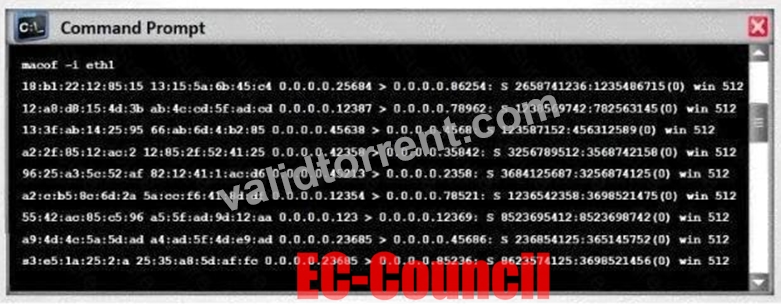
- A. The switch replaces outgoing frame switch factory default MAC address of FF:FF:FF:FF:FF:FF
- B. Every packet is dropped and the switch sends out SNMP alerts to the IDS port
- C. The CAM overflow table will cause the switch to crash causing Denial of Service
- D. Switch then acts as hub by broadcasting packets to all machines on the network
Answer: D
Explanation:
Comprehensive and Detailed Explanation:
In a MAC flooding attack, tools like macof (shown in the image) rapidly generate a large number of Ethernet frames with spoofed source MAC addresses. These are sent to the switch to overflow its CAM (Content Addressable Memory) table.
Once the CAM table is full:
The switch can no longer learn new MAC-to-port associations.
It fails open and starts broadcasting all incoming traffic to all ports.
This causes the switch to act like a hub.
Consequently, the attacker can:
Sniff traffic that would otherwise be switched.
Intercept data not destined for their system.
From CEH v13 Courseware:
Module 8: Sniffing # Switch-Based Attacks # MAC Flooding
Incorrect Options:
B: A switch typically does not crash but reverts to hub behavior.
C: There is no factory default override behavior like this.
D: Packets are not dropped-this would defeat the attack's purpose.
Reference:CEH v13 Study Guide - Module 8: MAC Flooding and Layer 2 AttacksCisco Security Best Practices - Switch CAM Table Protection
NEW QUESTION # 58
Which among the following is the best example of the hacking concept called "clearing tracks"?
- A. An attacker gains access to a server through an exploitable vulnerability.
- B. During a cyberattack, a hacker injects a rootkit into a server.
- C. After a system is breached, a hacker creates a backdoor to allow re-entry into a system.
- D. During a cyberattack, a hacker corrupts the event logs on all machines.
Answer: D
Explanation:
"Clearing tracks" is a post-exploitation phase in the ethical hacking methodology in which the attacker removes or alters system evidence to hide their activities and avoid detection. This may include:
* Deleting or modifying event logs
* Clearing bash history or command history
* Removing malware traces
* Disabling auditing
From CEH v13:
* Corrupting or erasing event logs ensures that system administrators or forensic investigators cannot trace the intrusion or determine how the system was compromised.
Incorrect Options:
* A. Creating a backdoor is part of the "Maintaining Access" phase, not "Clearing Tracks."
* B. Injecting a rootkit is part of the "Gaining or Maintaining Access" stage.
* C. Exploiting a vulnerability is part of the "Gaining Access" phase.
Reference - CEH v13 Official Courseware:
Module 05: System Hacking
Section: "Clearing Logs and Erasing Evidence"
Subsection: "Track-Clearing Techniques"
Lab: Log Manipulation and Covering Tracks
NEW QUESTION # 59
Within the context of Computer Security, which of the following statements describes Social Engineering best?
- A. Social Engineering is the act of publicly disclosing information
- B. Social Engineering is the means put in place by human resource to perform time accounting
- C. Social Engineering is the act of getting needed information from a person rather than breaking into a system
- D. Social Engineering is a training program within sociology studies
Answer: C
NEW QUESTION # 60
What is the most common method to exploit the "Bash Bug" or "Shellshock" vulnerability?
- A. SYN Flood
- B. Manipulate format strings in text fields
- C. SSH
- D. Through Web servers utilizing CGI (Common Gateway Interface) to send a malformed environment variable to a vulnerable Web server
Answer: D
NEW QUESTION # 61
......
312-50v13 Practice Exam and Study Guides - Verified By ValidTorrent: https://troytec.validtorrent.com/312-50v13-valid-exam-torrent.html