

[Jul 25, 2026] Latest D-PE-OE-01 Exam with Accurate Dell PowerEdge Operate v2 Exam PDF Questions
Practice To D-PE-OE-01 - ValidTorrent Remarkable Practice On your Dell PowerEdge Operate v2 Exam Exam
NEW QUESTION # 182
A technician wants to configure the iDRAC on a new server using the iDRAC Quick Sync 2 feature.
What is required to use this feature?
- A. OpenManage Mobile App installed on an Android or iOS device
- B. Quick Sync enabled bezel
- C. iDRAC Enterprise license
- D. OpenManage Mobile App installed on a laptop
Answer: A
NEW QUESTION # 183
A user has a drive failure on a server with four identical drives configured in a RAID 5 setup and no spare. The technician arrives and switches the bad drive with an identical new drive and completes a rebuild. A month later the user complains that the RAID configuration is a little slower than it was before the failure.
What action should the technician take?
- A. Run a Patrol Read
- B. Check if the firmware on the newly replaced drive matches the existing drives in the RAID configuration
- C. Replace the drive that was recently installed
- D. Power down the server, reseat the backplane cables on each drive then power on the server
Answer: B
NEW QUESTION # 184
What is an advantage of using virtual media from a management station?
- A. No physical presence is required at the data center.
- B. Remote file shares are supported.
- C. ISO can be transferred to the server using a USB flash drive.
- D. Management station can be separated from the server by firewalls or a DMZ.
Answer: A
Explanation:
Advantages of Using Virtual Media from a Management Station Server Management and Configuration Tools (14%) Define the function of the iDRAC, login procedures, licensing, and connection methods Explain the management interface options - LCC, racadm, OMSA, iSM, OME Understanding Virtual Media Virtual Media allows administrators to remotely mount media devices (such as CD/DVD drives or ISO images) over the network to a server via the Integrated Dell Remote Access Controller (iDRAC). Purpose: Enables tasks like installing an operating system, updating firmware, or running diagnostics without needing physical access to the server.
Advantages
Option B: No physical presence is required at the data center
Remote Accessibility: Administrators can perform necessary tasks from any location, eliminating the need to be physically present at the server's location.
Efficiency: Reduces travel time and costs associated with onsite visits.
Business Continuity: Allows for prompt responses to issues, minimizing downtime.
Dell Operate
Reference: Server Management and Configuration Tools (14%): Highlights the importance of remote management capabilities provided by tools like iDRAC and the Virtual Console.
Explanation of Other Options
Option A: ISO can be transferred to the server using a USB flash drive
Analysis: This involves physical transfer and insertion of a USB drive into the server, which contradicts the advantage of using virtual media remotely.
Conclusion: Not an advantage of virtual media from a management station.
Option C: Remote file shares are supported
Analysis: While some virtual media implementations may support remote file shares, the primary advantage is the ability to mount media remotely, not necessarily accessing file shares. Conclusion: Less accurate than Option B.
Option D: Management station can be separated from the server by firewalls or a DMZ Analysis: Firewalls and DMZs can actually hinder the use of virtual media due to blocked ports or security restrictions.
Conclusion: Not an advantage and may present challenges.
Conclusion
Using virtual media from a management station provides the significant advantage of allowing administrators to perform tasks without needing to be physically present at the data center. This enhances operational efficiency and responsiveness.
NEW QUESTION # 185
A technician needs to use the iDRAC GUI to roll back a diagnostics firmware revision on a server that was updated four weeks previously. However, the replaced version cannot be found in the Firmware Rollback section on the iDRAC GUI.
What could be the issue?
- A. Rollback feature was not enabled in iDRAC Settings
- B. Diagnostics firmware revision is part of the Lifecycle Controller firmware so the Lifecycle Controller must be updated first
- C. Diagnostics firmware is not supported in the Rollback feature.
- D. Firmware can only be rolled back within a week of being replaced.
Answer: C
NEW QUESTION # 186
A technician is working on an operational PowerEdge R640 server that cannot be rebooted. Observing that all drives are hot-swappable devices, the technician decides to remove a drive that has been giving intermittent errors. After the single drive is removed the operating system crashes.
What could have caused the operating system to crash?
- A. Drive was part of a RAID 0 virtual disk
- B. System Lockdown mode was enabled, which does not allow any component to be hot-swapped
- C. PERC was configured to allow a single drive removal
- D. iDRAC was not configured for hot-swappable components
Answer: A
NEW QUESTION # 187
A company has scheduled downtime for updates to one of their Enterprise licensed Dell PowerEdge systems. The technician responsible for the task wants to have the updates applied automatically during the downtime without having to install additional Dell software.
What step must the technician perform?
- A. Use the Automatic Updates feature in the Open Manage Server Administrator to schedule updates with reboot
- B. Use the Server Update utility to schedule an automatic update task with reboot
- C. Use the Platform Update feature in the Lifecycle Controller to schedule an update task with reboot
- D. Use the iDRAC Web Interface to schedule automatic updates with reboot
Answer: D
NEW QUESTION # 188
A new server has 128 GB of RAM and three 1 TB drives. After creating a RAID 5 array with the three internal drives on the system, a technician boots to the Lifecycle Controller to install Windows Server 2016. When the technician tries to select an install location, Windows displays an error message that states that it cannot be installed to that location.
What should the technician do to resolve this issue?
- A. Verify that the license for installing an OS to a virtual disk is installed
- B. Delete the array and use the Lifecycle Controller to configure the array
- C. Bring up the command prompt by pressing shift F10 and use the disk part to clean the disk
- D. Change the boot mode from BIOS to UEFI
Answer: D
NEW QUESTION # 189
A technician installs eight servers into a fully operational rack with top of rack switch Each server has a quad 1Gb NIC and redundant power supplies. The company uses iDRAC in shared LOM mode with LOM1 as the selected NIC.
What should the technician do to verify iDRAC connectivity on each server?
- A. Ethernet port LOM1 is cabled and the link light is green
- B. iDRAC dedicated NIC port is cabled and the link light is green
- C. iDRAC Enterprise license is installed
- D. iDRAC Datacenter license is installed.
Answer: B
NEW QUESTION # 190
A technician is using the iDRAC web GUI to upload a firmware that requires a reboot. They select the update and choose 'Apply Update and Reboot Now'.
How could the technician determine the status of the firmware update?
- A. Access the System Setup Utility > iDRAC Settings and check the completion status in the Job Queue.
- B. Access the Lifecycle Controller > Firmware Updates menu and check the completion status in the Job Queue.
- C. Log in to the iDRAC web GUI and check the completion status in the Job Queue.
- D. Monitor the iDRAC web interface for an "Updates Completed" message in the iDRA
Answer: C
NEW QUESTION # 191
A company operates a Dell PowerEdge server configured with a RAID 10 virtual disk that hosts critical databases services. Monitoring tools indicate that the virtual disk usage has reached 95% of total capacity.
The server provides 24/7 mission-critical services, so downtime must be minimized or completely avoided.
Currently, the server has only one empty drive bay remaining. What should the operations team consider first to safely plan the expansion of the RAID 10 virtual disk?
- A. Add the new disk and immediately perform Online Capacity Expansion through iDRAC.
- B. Add the new disk, trigger a rebuild of the RAID, and wait until the rebuild is complete before using the expanded capacity.
- C. Check the RAID controller's capabilities, available drive bays, and whether expansion is supported.
- D. Replace the RAID controller with the latest model to guarantee maximum performance, then add the new disk.
Answer: C
Explanation:
Planning a storage capacity expansion on a live enterprise production server hosting mission-critical databases necessitates verifying the architectural boundaries of the underlying PowerEdge storage subsystem. A RAID
10 virtual disk layout functions by striping data across multiple mirrored drive pairs (spans), meaning any structural expansion via Online Capacity Expansion (OCE) typically demands the simultaneous addition of an entire new mirror set, which requires a minimum of two physical disks. Because the physical chassis currently possesses only one unpopulated drive bay, executing a standard online expansion by dropping a single drive into the matrix is structurally impossible. Therefore, the operations team must first evaluate the PowerEdge RAID Controller (PERC) capabilities, confirm the exact physical drive slot constraints, and determine if alternative modification methods-such as sequentially swapping existing drives with higher-capacity units- are supported by the firmware. Attempting an immediate online capacity modification without inspecting controller constraints can lead to unexpected failures, and replacing the physical controller on a live production machine introduces severe operational downtime that violates the continuous availability mandate.
Study Guide References: Server Maintenance; PowerEdge RAID Controller (PERC) Operations; Online Capacity Expansion Constraints.
NEW QUESTION # 192
A Dell EMC PowerEdge server logs the following CPU Machine Check error: CPU1 IERR.
What action might be required to solve the alert?
- A. Update the Intel driver
- B. Reseat the IDSDM
- C. Swap the PERC controller
- D. Clear logs
Answer: A
NEW QUESTION # 193
A PowerEdge server is running critical production workloads and has passed all validation and compliance checks. The security team requires that no unauthorized or accidental changes be made to the system configuration during the production phase. Later, the administrator attempts to update the BIOS remotely using iDRAC but the operation fails without applying any changes. Which is the most likely reason for this behavior?
- A. Secure Boot is preventing the BIOS update
- B. The RAID controller is in a degraded state
- C. TPM is blocking the firmware operation
- D. System Lockdown Mode is enabled
Answer: D
Explanation:
Dell PowerEdge cyber-resilient security features include an integrated System Lockdown Mode designed to block unauthorized configuration changes across production environments. When an administrator activates System Lockdown Mode via iDRAC, the management subsystem applies a global execution block on all configuration settings and firmware modification vectors. This security policy explicitly blocks any firmware updates targeting the BIOS, iDRAC, Lifecycle Controller, power supply units, or storage controllers, regardless of whether the request originates from a valid administrator account or an external orchestration tool. Any attempt to stage a Dell Update Package (DUP) or initiate a remote firmware modification results in an immediate execution failure to protect the system's baseline status. To successfully apply a critical BIOS update or modify a managed variable, the administrator must explicitly disable System Lockdown Mode, perform the required infrastructure maintenance, and then re-enable the lockdown wrapper to restore full system protection.
Study Guide References: System Administration; Cyber Resilient Security; System Lockdown Mode Management.
NEW QUESTION # 194
What image does the iDRAC9 BIOS/UEFI Recovery feature use to flash a corrupt BIOS?
- A. Latest BIOS DUP from the online Dell catalog
- B. Latest BIOS DUP that the system is aware of
- C. Dell DUP supplied by the system administrator
- D. Last known good BIOS image
Answer: B
NEW QUESTION # 195
A technician is using the default installation of iSM.
Where can they find the replicated LC logs using the Windows Event Viewer?
- A. Application
- B. Forwarded Events
- C. Security
- D. System
Answer: D
NEW QUESTION # 196
A technician installs a NIC on a single CPU server. However, the NIC is not detected when they power on the server.
What should the technician verify to make sure that the NIC is detected correctly?
- A. NIC is installed in an expansion slot managed by the single CPU
- B. NIC driver is up to date
- C. Network cable is plugged into the newly installed NIC
- D. System Setup is set to BIOS boot mode
Answer: A
NEW QUESTION # 197
Refer to the exhibit.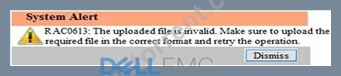
A technician tries to apply a BIOS update through the iDRAC web interface on a server using the Linux Dell Update Package file BIOS_2H4CC_LN_2 0.2.BIN. The error shown occurs. How should this error be fixed?
- A. Reset the iDRAC and reapply the update
- B. Extract the Linux Dell Update Package and apply payload file
- C. Download and apply the Windows Dell Update Package file
- D. Redownload the file to replace corrupted version and reinstall
Answer: C
NEW QUESTION # 198
Case Study 4
A company is experiencing a noticeable decrease in performance when accessing data purpose file shares. In addition, a file pool policy moves data that has not been modified for the slow data access.
The number of users accessing the cluster has not changed. The administrator has shared the following baseline metrics. The outputs were captured from a performance-acceptable time frame.
Trace route shows:
- 3 hops between clients and the cluster
- Average latency is 3 ms
Iperf shows:
- 940 Mb/s average bandwidth
- 005 ms average jitter
Netstat on the local network shows:
- 05% average re-transmission rate
Hostcache list:
- 20 ms average roundtrip time across all clients
The administrator shows you the following output from the netstat command:
- 32366653 data packets (35556615947 bytes)
- 8010 data packets (9525723 bytes) re-transmitted
Based on the output, what information should be provided to the administrator?
- A. Re-transmission rates have no impact on performance
- B. Change in the re-transmission rate indicates an issue
- C. Re-transmission rate exceeds recommendations
- D. Re-transmission rate is in the acceptable range
Answer: D
NEW QUESTION # 199
A technician working with a Dell EMC PowerEdge 1 take corrective action?
- A. Check the LCC Log, Check PSU LED, Reseat the PSU
- B. Check the LCC Log, Check PSU LED, Reseat the CPU
- C. Check the System Event Log, Check PSU LED, Do a virtual reseat of the iDRAC
- D. Check the System Event Log, Check PSU LED, Reseat the PSU
Answer: C
NEW QUESTION # 200
SIMULATION
Due to recent security breaches and to avoid accidental changes made by the junior IT staff, an administrator would like to prevent unwanted configuration changes in the iDRAC UI.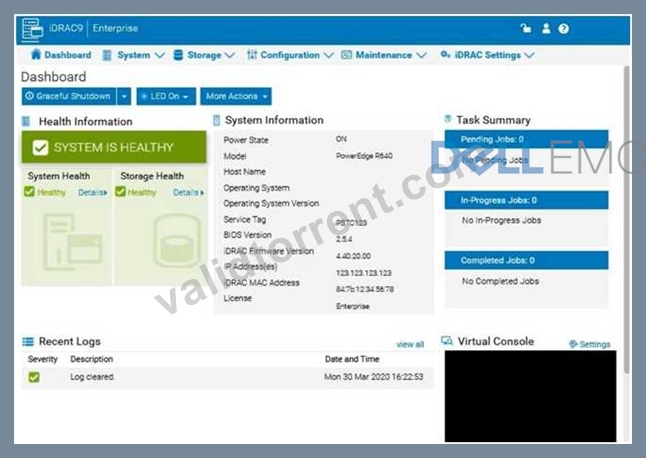
Answer:
Explanation:
Answer in Explanation
Explanation:
To prevent unwanted configuration changes in the iDRAC UI, you can adjust user roles, permissions,or enable specific security settings to restrict access for junior IT staff.
Here are the steps to securethe iDRAC configuration:
Step-by-Step Guide:
Access User Settings:
In the iDRAC interface, navigate to iDRAC Settings from the main menu. Choose User Authentication or Users to manage user accounts and permissions.
Adjust User Roles and Permissions:
Identify the accounts associated with junior IT staff.
For each user account, adjust the role to Read-Only if you want them to have view-only access without making configuration changes.
Alternatively, set their permissions to exclude configuration changes. This may involve assigning a custom role with limited access based on your needs.
Enable Configuration Lock (if available):
Some versions of iDRAC offer a Configuration Lock feature, which prevents any configuration changes until the lock is removed by an administrator.
Navigate to Configuration > System Security or User Authentication, depending on the version, and enable the Configuration Lock option.
Set Up Two-Factor Authentication (Optional):
For added security, enable Two-Factor Authentication under iDRAC Settings > Network or Security settings. This step ensures only authorized users can access and make changes to the iDRAC UI.
Save and Apply Security Changes:
After setting up the desired restrictions and permissions, save the settings to apply the changes. Verify that junior IT staff accounts now have restricted access and cannot make configuration changes.
Log Out and Test the Changes:
Log out of the administrator account and log in with a junior IT staff account to confirm that the permissions are set correctly.
Ensure that configuration changes are disabled and that the user can only view the iDRAC interface as per the restrictions.
By following these steps, you can restrict junior IT staff from making any configuration changes within the iDRAC interface, thus preventing accidental or unauthorized modifications.
NEW QUESTION # 201
A customer is attempting to install Windows Server 2022 on a Dell PowerEdge R740. However, Windows Server 2022 is not listed in the Available Operating Systems list in the Lifecycle Controller > OS Deployment Wizard.
How can the customer add Windows Server 2022 to the list?
- A. Update OS driver pack
- B. Update BIOS
- C. Change boot mode to UEFI
- D. Change installation source
Answer: A
NEW QUESTION # 202
You are managing PowerEdge Servers in different locations across the globe. Your security team instructed you to apply specific settings and firmware on the BIOS to comply with Company policies. You must ensure these applied settings and firmware do not change or have anomalies overtime. How could you achieve this?
- A. Use DC-HPM
- B. Use BIOS Live Scanning
- C. Use Enterprise Key Management
- D. Use iDRAC Credential Vault
- E. Use DC-MHS
Answer: B
Explanation:
Dell PowerEdge servers feature advanced cyber-resilient architectures designed to enforce configuration baseline integrity and eliminate configuration drift across enterprise deployments. When security policies require that globally deployed BIOS configuration options and cryptographic firmware structures remain absolutely locked against unauthorized alteration or external corruption, administrators must leverage the BIOS Live Scanning feature. Available under the iDRAC Datacenter tier license, BIOS Live Scanning enables continuous out-of-band validation of the primary ROM image without requiring host operating system intervention or incurring system downtime. This background security daemon executes cryptographically signed checksum comparisons on critical immutable boot blocks either on-demand or automatically via a scheduled frequency. If any structural modification, unauthorized firmware flash attempt, or memory bit anomaly is detected during runtime operations, iDRAC instantly records the tamper event within the Lifecycle Controller Logs and System Event Logs. This feature ensures total transparency and compliance verification across distributed multi-region infrastructures without degrading production computing performance.
Study Guide References: System Administration; Cyber Resilient Security; iDRAC Datacenter Telemetry Subsystems.
NEW QUESTION # 203
Which three components do Dell PowerEdge Servers leverage to maximize Al workload throughput? (Select 3)
- A. ASIC
- B. DPU
- C. FPGA
- D. GPU
- E. CPU
Answer: C,D,E
Explanation:
Understanding Components that Maximize AI Workload Throughput in Dell PowerEdge Servers Server Components (26%) Explain how expansion cards are connected and the features of the GPU, NDC, LOM, and OCP options Define the different processor, memory options, and memory configurations Overview Dell PowerEdge servers are designed to handle demanding workloads, including Artificial Intelligence (AI) applications. To maximize AI workload throughput, these servers leverage specific components that enhance computational capabilities and data processing efficiency. Components that Maximize AI Workload Throughput CPU (Central Processing Unit) The CPU is the primary processor in a server, responsible for executing general computing tasks. In AI workloads, CPUs handle tasks that require complex logic and sequential processing.
Features in Dell PowerEdge Servers:
High core counts for parallel processing.
Support for advanced instruction sets optimized for AI computations. Multi-threading capabilities to handle multiple processes simultaneously. GPU (Graphics Processing Unit) GPUs are specialized processors designed to handle parallel processing tasks efficiently. They excel in performing the matrix and vector operations common in AI algorithms, such as deep learning and neural networks.
Features in Dell PowerEdge Servers:
Integration of high-performance GPUs from leading vendors like NVIDIA.
Support for multiple GPUs in a single server to scale performance.
High memory bandwidth to handle large datasets.
FPGA (Field-Programmable Gate Array)
FPGAs are integrated circuits that can be configured by the customer or designer aftermanufacturing. They offer customizable hardware acceleration for specific tasks, making themsuitable for specialized AI applications.
Features in Dell PowerEdge Servers:
Ability to offload specific AI algorithms for faster processing.
Reconfigurable to adapt to different AI models or workloads.
Lower latency compared to general-purpose processors.
Evaluation of Options
Option A: DPU (Data Processing Unit)
DPUs are specialized processors designed to offload networking and storage tasks from the CPU. While beneficial for certain workloads, they are not primarily used to maximize AI workload throughput in Dell PowerEdge servers.
Conclusion: Not one of the primary components leveraged for AI workloads.
Option B: ASIC (Application-Specific Integrated Circuit)
ASICs are custom-designed chips optimized for a particular application. While they can be used in AI applications, they are not commonly leveraged in Dell PowerEdge servers for AI workload throughput.
Conclusion: Not a standard component in Dell PowerEdge servers for AI workloads.
Option C: FPGA
Correct Answer. FPGAs are leveraged in Dell PowerEdge servers to accelerate AI workloads throughhardware customization.
Option D: GPU
Correct Answer. GPUs are extensively used in Dell PowerEdge servers to maximize AI workload throughput due to their parallel processing capabilities.
Option E: CPU
Correct Answer. CPUs are fundamental components that, when combined with GPUs and FPGAs, contribute to maximizing AI workload throughput.
Dell Operate Reference
Server Components (26%):
Understanding how CPUs, GPUs, and FPGAs function and their roles in enhancing server performance for AI workloads is crucial.
Define the different processor, memory options, and memory configurations: Knowledge of CPU capabilities is essential.
Explain how expansion cards are connected and the features of the GPU, NDC, LOM, and OCP options: Understanding GPU and FPGA integration into servers.
Conclusion
Dell PowerEdge servers leverage CPUs, GPUs, and FPGAs to maximize AI workload throughput. These components work together to provide the necessary computational power and efficiency required for demanding AI applications.
NEW QUESTION # 204
......
Exam Questions and Answers for D-PE-OE-01 Study Guide Questions and Answers!: https://troytec.validtorrent.com/D-PE-OE-01-valid-exam-torrent.html