

NSE7_CDS_AR-7.6 Exam Dumps Pass with Updated May-2026 Tests Dumps
NSE7_CDS_AR-7.6 exam questions for practice in 2026 Updated 76 Questions
Fortinet NSE7_CDS_AR-7.6 Exam Syllabus Topics:
| Topic | Details |
|---|---|
| Topic 1 |
|
| Topic 2 |
|
| Topic 3 |
|
| Topic 4 |
|
NEW QUESTION # 39
An administrator decides to use the Use managed identity option on the FortiGate SDN connector with Microsoft Azure. However, the SDN connector is failing on the connection. What must the administrator do to correct this issue?
- A. Make sure to add the Tenant ID on the FortiGate side of the configuration.
- B. Make sure to enable the system-assigned managed identity on Azure.
- C. Make sure to set the type to system managed identity on FortiGate SDN connector settings.
- D. Make sure to add the Client Secret on the FortiGate side of the configuration.
Answer: B
NEW QUESTION # 40
What are two main features in Amazon Web Services (AWS) network access control lists (NACLs)? (Choose two answers)
- A. NACLs are tied to an instance.
- B. You cannot use NACLs and Security Groups at the same time.
- C. NACLs are stateless, and inbound and outbound rules are used for traffic filtering.
- D. The default NACL is configured to allow all traffic.
Answer: C,D
Explanation:
Comprehensive and Detailed Explanation From FortiOS 7.6, FortiWeb 7.4 Exact Extract study guide:
As per theFortiOS 7.6 AWS Administration GuideandFortiWeb 7.4cloud deployment documentation, understanding the AWS infrastructure layer is critical for integrating Fortinet virtual appliances. The two features that define AWS Network Access Control Lists (NACLs) are:
* Stateless Nature (Option A):Unlike Security Groups, which are stateful (automatically allowing return traffic), NACLs arestateless. This means that if you allow inbound traffic on a specific port, you must also explicitly configure an outbound rule to allow the response traffic to leave the subnet. NACLs evaluate inbound and outbound traffic independently.
* Default Configuration (Option C):Every VPC comes with adefault NACL. By default, this NACL is configured toallow all inbound and outbound traffic. This is designed to ensure connectivity is not blocked until a custom security posture is defined. However, any custom NACL created manually starts by denying all traffic until rules are added.
Why other options are incorrect:
* Option B:NACLs are associated at thesubnet level, not the instance level. Security Groups are the components tied directly to an instance's Elastic Network Interface (ENI).
* Option D:NACLs and Security Groups providedefense-in-depthand are designed to be used simultaneously. Traffic must pass through the NACL (subnet level) and then the Security Group (instance level) to reach its destination.
NEW QUESTION # 41
Which statement about immutable infrastructure in automation is true?
- A. It is the practice of applying hotfixes and OS patches after deployment.
- B. It is the practice of modifying the existing server configuration after it is deployed.
- C. It is the practice of deploying a new server for every configuration change.
- D. It is the practice of deploying two parallel servers for high availability.
Answer: C
Explanation:
Immutable infrastructure means that servers are never modified after deployment. Instead, any configuration change or update is applied by deploying a new server instance with the desired configuration, ensuring consistency and reducing configuration drift.
NEW QUESTION # 42
A DevOps team is configuring Terraform to deploy Amazon Web Services (AWS) resources.
They want to use environment variables to authenticate Terraform with AWS, while ensuring that the setup works across multiple developers' machines without exposing credentials in configuration files.
Which two environment variables must the team configure, at a minimum, to allow Terraform to authenticate with AWS? (Choose two.)
- A. AWS_ROLE_ARN
- B. AWS_ACCOUNT_ID
- C. AWS_ACCESS_KEY_ID
- D. AWS_SECRET_ACCESS_KEY
Answer: C,D
NEW QUESTION # 43
Refer to the exhibit.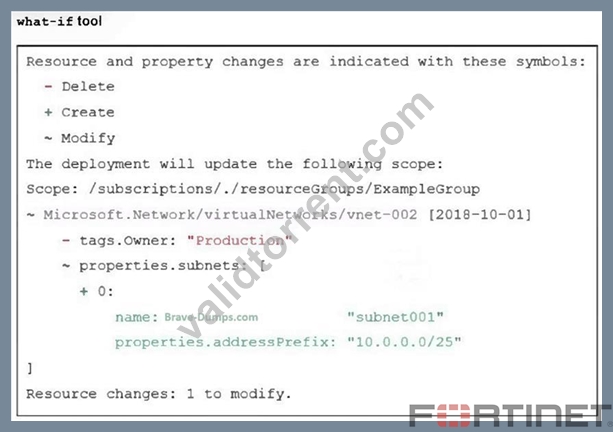
An administrator used the what-if tool to preview the changes to an Azure Bicep file. What will happen if the administrator applies these changes in Azure? (Choose one answer)
- A. The resulting VNet will have a single subnet.
- B. The vnet-002 VNet will be renamed Production.
- C. A new subnet will be added to vnet-002.
- D. The VNet address space will be updated.
Answer: C
Explanation:
Comprehensive and Detailed Explanation From FortiOS 7.6, FortiWeb 7.4 Exact Extract study guide:
Based on theFortiOS 7.6 Azure Administration Guideand standardAzure Resource Manager (ARM) deployment practices, the what-if operation allows administrators to preview how a deployment will affect the current state of resources.
* Interpreting the What-If Output (Option A):The exhibit shows the results of a change preview for a Virtual Network (vnet-002).
* The symbol~ (Modify)next to the VNet indicates that an existing resource is being updated rather than created or deleted.
* The symbol- (Delete)next to tags.Owner: "Production" indicates that this specific tag will be removed from the VNet.
* Crucially, the symbol+ (Create)appearing inside the properties.subnets array next to index 0:
indicates the addition of a new element. This confirms that anew subnetnamed subnet001 with the address prefix 10.0.0.0/25 will beaddedto the existing Virtual Network vnet-002.
* Why other options are incorrect:
* Option B:The text shows that the tag "Production" is beingdeleted(-), not that the VNet is being renamed to "Production."
* Option C:The what-if tool only displays thechanges. While one subnet is being added (+), the tool does not show the deletion of other existing subnets. Therefore, we cannot conclude the resulting VNet will haveonlya single subnet; it will have its existing subnets plus the new one.
* Option D:There is no mention of addressSpace or addressPrefixes for the VNet itself being modified (~) or added (+) in the exhibit; only a subnet-level address prefix is shown.
NEW QUESTION # 44
Refer to the exhibit. An administrator has deployed a FortiGate VM in Amazon Web Services (AWS) and is trying to access it using its public IP address from their local computer. However, the connection is not successful, and at the same time FortiGate is not receiving any HTTPS or SSH traffic to its external interface.
What should the administrator check for possible issue?
- A. Check the FortiGate firewall policies.
- B. Check the debug flow for any network ACLs.
- C. Check the FortiGate instance ID.
- D. Check the inbound rules of the security groups.
Answer: D
Explanation:
Since the FortiGate VM is not receiving any HTTPS or SSH traffic at all, the most likely cause is that the inbound rules of the AWS Security Group attached to the FortiGate instance are not permitting traffic on ports 22 (SSH) or 443 (HTTPS). If the Security Group blocks traffic, packets never reach FortiGate, which explains the absence of captured traffic.
NEW QUESTION # 45
Refer to the exhibit.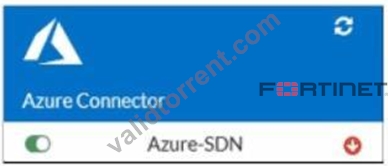
You are troubleshooting a Microsoft Azure SDN connector issue on your FortiGate VM in Azure.
Which command can you use to examine details about API calls sent by the connector?
- A. get system sdn-connector
- B. diag debug application azd -1
- C. diag debug application cloud-connector -1
- D. diag test application azd 1
Answer: B
NEW QUESTION # 46
Refer to the exhibit. An administrator used the what-if tool to preview changes to an Azure Bicep file. What will happen if the administrator decides to apply these changes in Azure?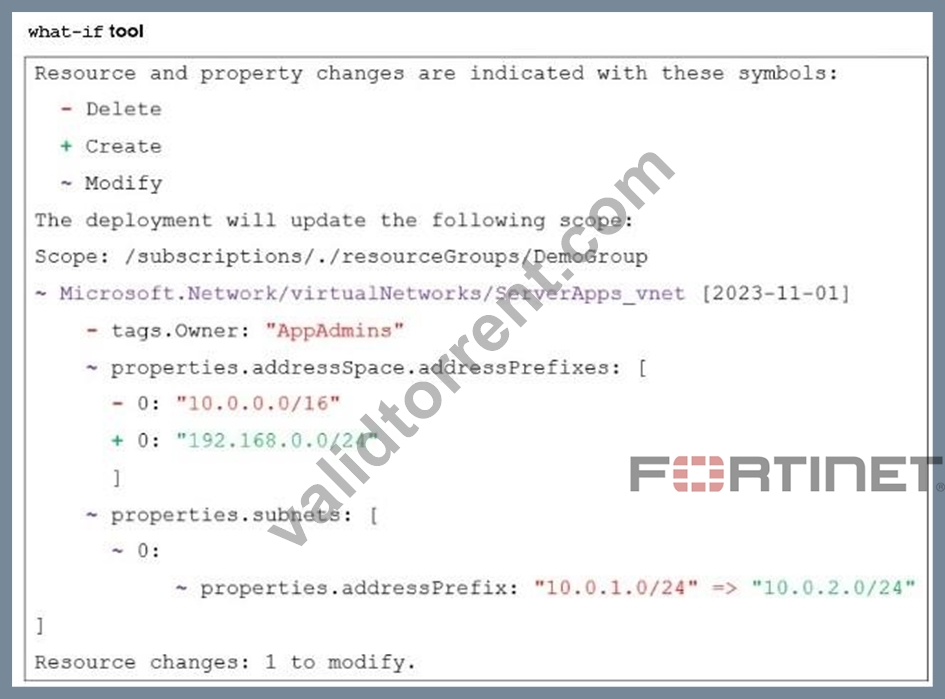
- A. This deployment will fail and no changes will be applied.
- B. Subnet 10.0.1.0/24 will replace subnet 10.0.2.0/24.
- C. The ServerApps VNet will be renamed.
- D. A new subnet will be added to ServerApps.
Answer: D
Explanation:
The what-if output shows that the ServerApps VNet will be modified:
* A new address prefix 192.168.0.0/24 will be added.
* An existing subnet will be modified from 10.0.1.0/24 to 10.0.2.0/24.
Since these are additive and modification changes within the VNet, the result is that a new subnet will be added alongside the update to the existing subnet.
NEW QUESTION # 47
Refer to the exhibit. Your team notices an unusually high volume of traffic sourced at one of the organizations FortiGate EC2 instances. They create a flow log to obtain and analyze detailed information about this traffic. However, when they checked the log, they found that it included traffic that was not associated with the FortiGate instance in question.
What can they do to obtain the correct logs?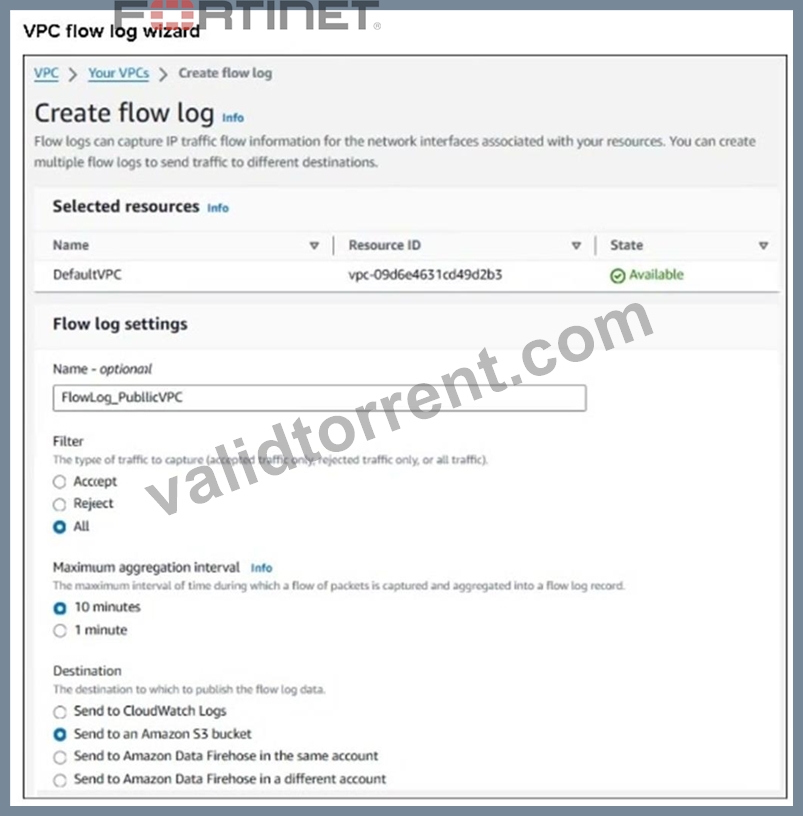
- A. Create a new flow log at the interface level.
- B. Change the maximum aggregation time to 1 minute.
- C. Send the logs to Amazon Data Firehose instead to get more granular information.
- D. Ensure that the flow log data is not mixed with the rest of the traffic.
Answer: A
Explanation:
VPC flow logs can be created at the VPC, subnet, or network interface (ENI) level. If you create them at the VPC level (as shown in the exhibit), the logs will include traffic from all resources in that VPC. To capture logs only for the FortiGate EC2 instance, you must create a new flow log at the specific network interface (ENI) level of that instance.
NEW QUESTION # 48
An administrator implements FortiWeb ingress controller to protect containerized web applications in an AWS Elastic Kubernetes Service (EKS) cluster.
What can you conclude about the topology shown in FortiView?
- A. Adding a new service will update the FortiWeb configuration automatically.
- B. This topology has two services and two ingress controllers deployed.
- C. Both services will be load balanced among the two nodes and the four pods.
- D. The FortiWeb VM gets the latest cluster information through an SDN connector.
Answer: D
NEW QUESTION # 49
An administrator implements FortiWeb ingress controller to protect containerized web applications in an AWS Elastic Kubernetes Service (EKS) cluster.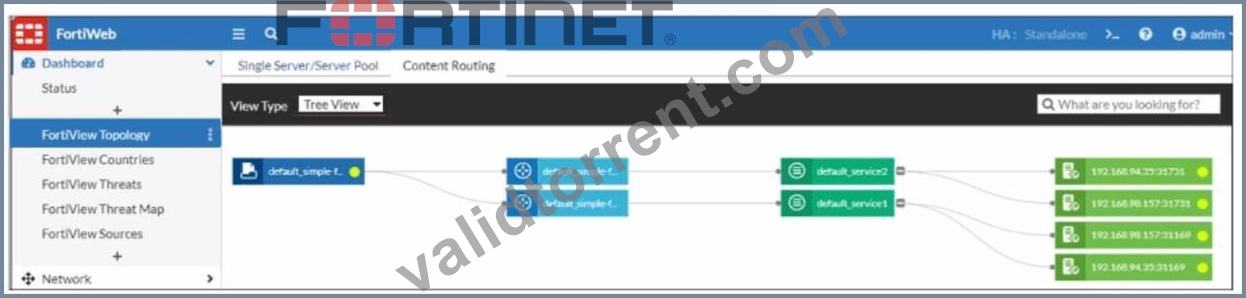
What can you conclude about the topology shown in FortiView?
- A. Adding a new service will update the FortiWeb configuration automatically.
- B. This topology has two services and two ingress controllers deployed.
- C. Both services will be load balanced among the two nodes and the four pods.
- D. The FortiWeb VM gets the latest cluster information through an SDN connector.
Answer: D
NEW QUESTION # 50
Your DevOps team is evaluating different Infrastructure as Code (IaC) solutions for deploying complex Azure environments.
What is an advantage of choosing Azure Bicep over other IaC tools available?
- A. Azure Bicep generates deployment logs that are optimized to improve error handling.
- B. Azure Bicep requires less frequent schema updates than Azure Resource Manager (ARM) templates.
- C. Azure Bicep can reduce deployment costs by limiting resource utilization during testing.
- D. Azure Bicep provides immediate support for all Azure services, including those in preview.
Answer: D
Explanation:
A key advantage of Azure Bicep is that it provides immediate support for all Azure services, including preview features, because it is a transparent abstraction over ARM templates. This ensures that any new Azure service or property is available in Bicep as soon as it is supported in ARM.
NEW QUESTION # 51
You are using Ansible to modify the configuration of several FortiGate VMs. What is the minimum number of files you need to create, and in which file should you configure the target FortiGate IP addresses?
- A. One text file for all target devices, and one playbook file.
- B. One playbook file for each target and the required tasks, and one inventory file.
- C. One .yaml file with the targets IP addresses, and one playbook file with the tasks.
- D. One inventory file for each target device, and one playbook file.
Answer: A
NEW QUESTION # 52
Refer to the exhibit.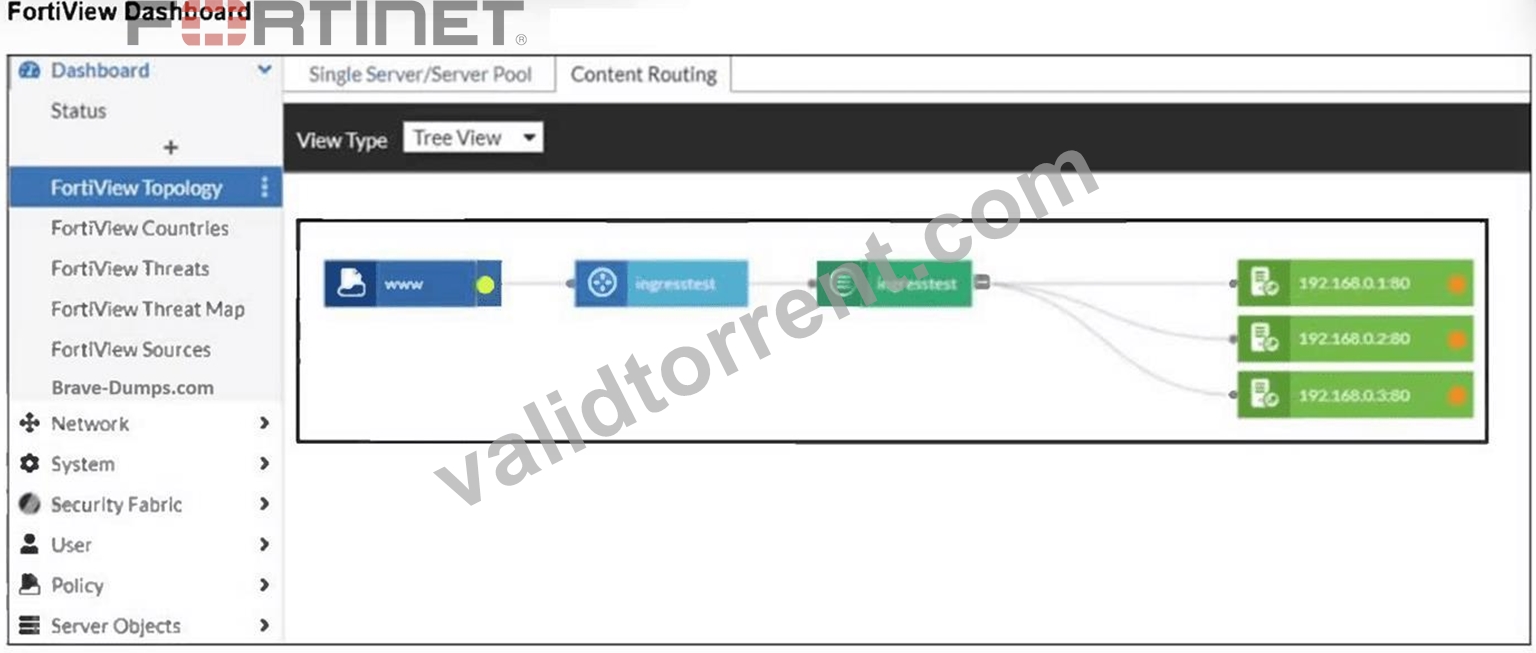
An administrator installed a FortiWeb ingress controller to protect a containerized web application. What is the reason for the status shown in FortiView? (Choose one answer)
- A. The SDN connector is not authenticated correctly.
- B. The load balancing type is not set to round-robin.
- C. The FortiWeb VM is missing a route to the node subnet.
- D. The manifest file deployed is configured with the wrong node IP addresses.
Answer: C
Explanation:
Comprehensive and Detailed Explanation From FortiOS 7.6, FortiWeb 7.4 Exact Extract study guide:
According to theFortiWeb 7.4 Administration Guideand theFortiWeb Ingress Controller Installation Guide, the status of backend servers in the FortiView Topology dashboard is a direct reflection of the health check results.
* Interpreting the Status Icon (Orange):In the FortiView Topology view, agreencircle indicates that the server is up and responding to health checks, while anorangecircle indicates that the server isnot runningor is unreachable.
* Connectivity and Routing (Option B):For the FortiWeb ingress controller to accurately monitor and protect a containerized application, it must have a valid network path to the Kubernetes (K8s) worker nodes. If theFortiWeb VM is missing a routeto the specific subnet where the K8s nodes reside, the health check packets will fail to reach their destination. As a result, FortiWeb identifies the backend servers (192.168.0.1, 192.168.0.2, and 192.168.0.3) as "Down," leading to the orange status shown in the exhibit.
* Health Check Failures:When the status is orange, it implies that theServer Health Check(configured in the server pool) is detecting that the web servers are not responsive to connections. While this could be caused by an application-level failure, in a fresh cloud deployment of an ingress controller, the most common underlying cause is anetwork routing misconfigurationpreventing the FortiWeb appliance from reaching the node IPs.12 Why other options are incorrect:34
* Option A:If the SDN connector were not authenticated correctly, FortiWeb would likely fail to discover the containerized resources entirely, rather than discovering them and repor5ting them as
"Down".6
* Option C:While wron7g IP addresses would cause a failure, the Ingress Controller's job is to dynamically sync these addresses from the K8s API; a manual configuration error in a manifest file regarding IP addresses is less likely in an automated ingress environment.
* Option D:The load balancing algorithm (Round Robin, Least Connections, etc.) affects how traffic is distributed, but it does not influence theup/down health statusof the individual backend servers.
NEW QUESTION # 53
Refer to the exhibit.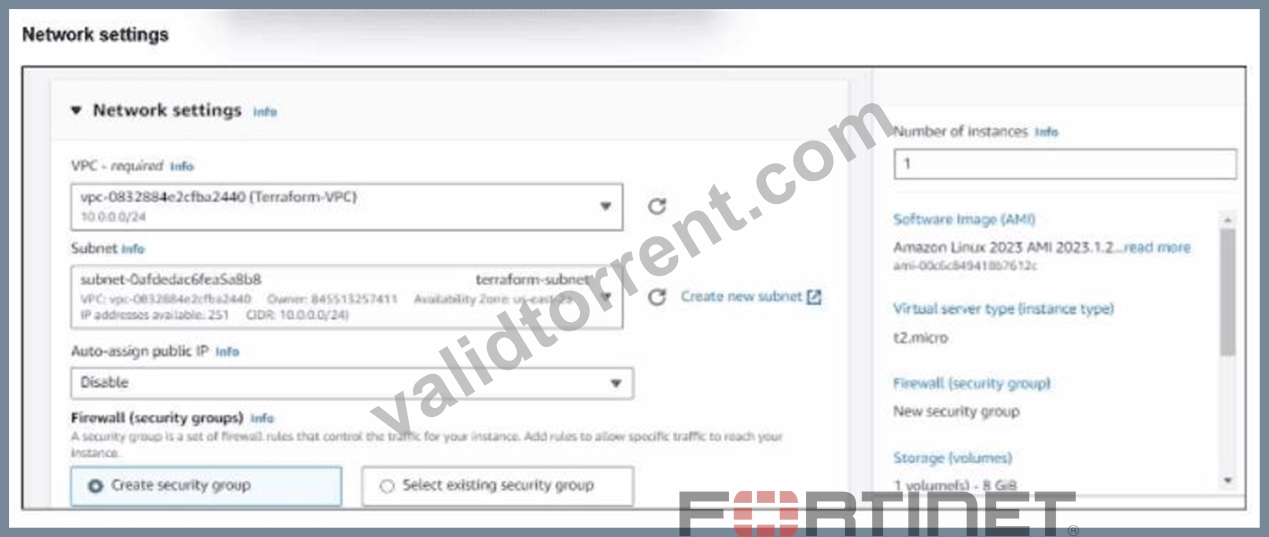
You have deployed a Linux EC2 instance in Amazon Web Services (AWS) with the settings shown on the exhibit.
What next step must the administrator take to access this instance from the internet?
- A. Enable SSH and allocate it to the device.
- B. Allocate an Elastic IP address and assign it to the instance.
- C. Configure the user name and password.
- D. Create a VIP on FortiGate to allow access.
Answer: B
NEW QUESTION # 54
......
Authentic NSE7_CDS_AR-7.6 Dumps With 100% Passing Rate Practice Tests Dumps: https://troytec.validtorrent.com/NSE7_CDS_AR-7.6-valid-exam-torrent.html