

100% Passing Guarantee - Brilliant CC Exam Questions PDF [Apr-2026]
CC Dumps 2026 - NewISC CC Exam Questions
NEW QUESTION # 130
An IoT (Internet of Things) device is typified by its effect on or use of the _____ environment.
- A. Philosophical
- B. Remote
- C. Physical
- D. Internal
Answer: C
NEW QUESTION # 131
Set of rules that everyone must comply with and usually carry monetary penalties for noncompliance
- A. Laws or Regulations
- B. Procedure
- C. Policy
- D. Standard
Answer: D
NEW QUESTION # 132
Which provides confidentiality by hiding or obscuring a message so it cannot be understood by unauthorized parties?
- A. Cryptography
- B. All
- C. Encoding
- D. Hashing
Answer: A
Explanation:
Cryptography provides confidentiality by encrypting data so only authorized parties can read it. Hashing ensures integrity, and encoding is reversible and not secure.
NEW QUESTION # 133
Load balancing primarily safeguards which CIA triad element?
- A. Availability
- B. Integrity
- C. All
- D. Confidentiality
Answer: A
Explanation:
Load balancing improves availability by distributing traffic across multiple systems, preventing overload and downtime.
NEW QUESTION # 134
Which of the following statements is true?
- A. It is best to use a blend of controls in order to provide optimum security.
- B. Physical access controls can protect the IT environment perfectly; there is no reason to deploy any other controls.
- C. Logical access controls can protect the IT environment perfectly; there is no reason to deploy any other controls.
- D. Administrative access controls can protect the IT environment perfectly; there is no reason to deploy any other controls.
Answer: A
NEW QUESTION # 135
What does the concept of integrity applied to
- A. Information system and processes for business operations
- B. Organization
- C. ALL
- D. People
Answer: C
NEW QUESTION # 136
What is meant by non-repudiation?
- A. If a user does something, they can't later claim that they didn't do it.
- B. It is part of the rules set by administrative controls.
- C. It is a security feature that prevents session replay attacks.
- D. Controls to protect the organization's reputation from harm due to inappropriate social media postings by employees, even if on their private accounts and personal time.
Answer: A
NEW QUESTION # 137
Exhibit.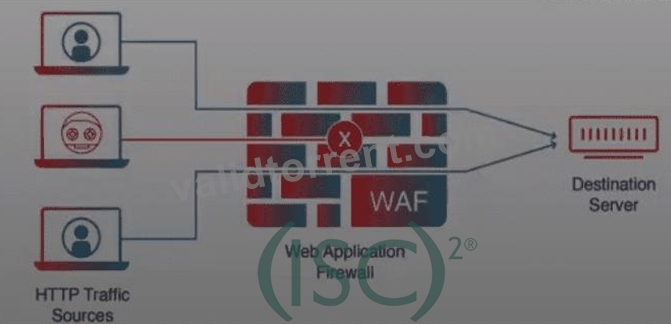
What is the PRIMARY purpose of a web application firewall (WAF)?
- A. To manage SSL certificates
- B. To monitor network traffic for intrusions
- C. To protect the web server from DDoS attacks
- D. To filter and block malicious web traffic and requests
Answer: D
Explanation:
The primary purpose of aWeb Application Firewall (WAF)is tofilter, monitor, and block malicious HTTP
/HTTPS trafficdirected at web applications. A WAF operates at theapplication layer (Layer 7)of the OSI model and is specifically designed to protect web applications from common attacks such as SQL injection, cross-site scripting (XSS), command injection, and other OWASP Top 10 vulnerabilities.
Unlike traditional network firewalls, which focus on IP addresses, ports, and protocols, a WAF understands web-specific traffic patterns and inspects the content of HTTP requests and responses. This allows it to detect malicious payloads embedded in URLs, headers, cookies, and request bodies.
While some WAFs may offer limited protection against application-layer DDoS attacks, DDoS mitigation is not their primary function. Intrusion detection is typically handled by IDS/IPS solutions, and SSL certificate management is unrelated to WAF functionality.
Security frameworks such as NIST and OWASP recommend WAFs as a critical compensating control for protecting public-facing web applications, especially when secure coding fixes cannot be deployed immediately.
NEW QUESTION # 138
What does the termbusinessin business continuity planning refer to?
- A. The financial performance of the organization
- B. The physical infrastructure of the organization
- C. The operational aspects of the organization
- D. The technical systems of the organization
Answer: C
Explanation:
In Business Continuity Planning (BCP), the termbusinessrefers primarily to theoperational aspects of the organization-the people, processes, and activities required to deliver products and services. While IT systems, finances, and facilities support operations, BCP focuses on ensuring thatcritical business functions continueduring and after disruptions.
This includes customer service, supply chain operations, payroll, compliance activities, and decision-making processes. BCP is broader than disaster recovery, which focuses mainly on restoring IT systems. According to NIST SP 800-34, business continuity emphasizes mission-essential functions and their dependencies, including personnel, third parties, facilities, and technology.
NEW QUESTION # 139
Which uses encrypted, machine-generated codes to verify a user's identity?
- A. Token-based authentication
- B. Form-based authentication
- C. Basic authentication
- D. All
Answer: A
Explanation:
Token-based authentication relies on encrypted, machine-generated tokens to verify a user's identity. After successful authentication, the system issues a token (often a JSON Web Token or OAuth token) that represents the user's session or authorization claims. This token is then presented with each request instead of repeatedly transmitting credentials.
Unlike basic or form-based authentication, token-based methods reduce exposure of usernames and passwords, improve scalability, and support modern distributed architectures such as APIs, cloud services, and mobile applications. Tokens can also include expiration times and scopes, improving security control.
NEW QUESTION # 140
Which of the following is an example of a "something you are" authentication factor?
- A. A credit card presented to a cash machine
- B. A photograph of your face
- C. A user ID
- D. Your password and PIN
Answer: B
NEW QUESTION # 141
Load balancing safe guard which CIA triad
- A. Integrity
- B. All
- C. Availablity
- D. Confidentiality
Answer: C
NEW QUESTION # 142
Are events that may indicate that an organization's systems or data have been compromised or that protective measures have failed.
- A. Exploit
- B. Breach
- C. Security incident
- D. Threat
Answer: C
Explanation:
Asecurity incidentis an event or series of events that indicates a possible compromise of confidentiality, integrity, or availability of information systems or data. According to NIST SP 800-61, incidents include attempted or successful unauthorized access, misuse, modification, or denial of service.
Not all incidents result in breaches, but all breaches are incidents. Incidents trigger incident response processes, investigations, and potential escalation depending on severity.
NEW QUESTION # 143
True or False: The IT department is responsible for creating the organization's Business Continuity Plan.
- A. False
- B. True
Answer: A
Explanation:
BCP is anorganization-wide responsibility. While IT plays a key role, BCP requires participation from all business units, leadership, HR, facilities, and external partners.
NEW QUESTION # 144
What is an incident in the context of cybersecurity
- A. A deliberate security incident in which an intruder gains access to a system or system resource without authorization
- B. Any observable occurrence in a network or system
- C. An event that actually or potentially jeopardizes the confidentiality integrity or availability of an information system.
- D. A particular attack that exploits system vulnerabilities
Answer: C
NEW QUESTION # 145
Which of the following is not an element of system security configuration management
- A. Audit logs
- B. Updates
- C. Inventory
- D. Baselines
Answer: A
NEW QUESTION # 146
Events with a negative consequence, such as system crashes, network packet floods, unauthorized use of system privileges, defacement of a web page or execution of malicious code that destroys data.
- A. Adverse Event
- B. Exploit
- C. Breach
- D. Incident
Answer: A
NEW QUESTION # 147
What is the difference between BCP and DRP
- A. DRP and BCP are the same
- B. DRP is about restoring IT and communications back to full operations after a disruption, while BCP i about maintaining critical business functions
- C. BCP is about restoring IT and communications back to full operations after a disruption, while DRP is about maintaining critical business functions
- D. BCP is about maintaining critical business functions before a disaster occurs
Answer: B
NEW QUESTION # 148
What is the purpose of a Business Impact Analysis (BIA)?
- A. Restore IT services
- B. Mitigate security violations
- C. Analyze system requirements to determine recovery priorities
- D. Provide DRP overview
Answer: C
Explanation:
A BIA identifies critical systems, dependencies, and acceptable downtime to establish recovery priorities.
NEW QUESTION # 149
What does Personally Identifiable Information (PII) pertain to?
- A. Information about an individual's health status
- B. The importance assigned to information by its owner
- C. Data about an individual that could be used to identify them
- D. Trade secrets, research, business plans, and intellectual property
Answer: C
Explanation:
Personally Identifiable Information (PII) refers to any data that can be used to identify a specific individual, either directly or indirectly. Examples include full name, Social Security number, date of birth, address, email address, phone number, and biometric identifiers.
PII is regulated by numerous laws and standards, including privacy regulations and data protection frameworks. Protecting PII is critical to prevent identity theft, fraud, and privacy violations.
Health information is a subset of sensitive data (often classified as PHI). Trade secrets and business data fall under intellectual property. Information classification levels describe value, not identity.
Security controls for PII typically include encryption, access control, monitoring, and data loss prevention mechanisms.
NEW QUESTION # 150
When should a business continuity plan (BCP) be activated?
- A. When instructed to do so by regulators
- B. When senior management decides
- C. At the very beginning of a disaster
- D. As soon as possible
Answer: B
NEW QUESTION # 151
Which layer provides services directly to the user?
- A. Presentation Layer
- B. Physical Layer
- C. Session Layer
- D. Application Layer
Answer: D
Explanation:
TheApplication Layer (Layer 7)of the OSI model provides services directly to the user and user-facing applications. This layer supports protocols such as HTTP, HTTPS, SMTP, FTP, and DNS, which enable web browsing, email, file transfers, and name resolution.
While users interact with applications rather than the OSI model itself, the Application Layer is responsible for enabling those interactions. The Session Layer manages session establishment, the Presentation Layer handles data formatting and encryption, and the Physical Layer transmits raw bits over physical media.
From a security perspective, many attacks target the Application Layer, including SQL injection, cross-site scripting (XSS), and authentication bypasses. As a result, application-layer security controls such as WAFs, secure coding practices, and input validation are critical.
Understanding OSI layers helps security professionals design layered defenses and properly place controls.
NEW QUESTION # 152
The first phase of the System Development Life Cycle (SDLC) is:
- A. Requirements analysis
- B. Design
- C. Development
- D. Feasibility study
Answer: D
Explanation:
The feasibility study determines whether a project is technically, economically, and operationally viable before development begins.
NEW QUESTION # 153
......
ISC CC Exam Syllabus Topics:
| Topic | Details |
|---|---|
| Topic 1 |
|
| Topic 2 |
|
| Topic 3 |
|
| Topic 4 |
|
| Topic 5 |
|
Free CC braindumps download: https://troytec.validtorrent.com/CC-valid-exam-torrent.html